Cloud migration wave planning often looks sensible on paper, until execution exposes the dependencies nobody fully mapped.
In the latest post in my Waltz-based cloud migration series, I look at why migration waves should not be built only around team preference, application priority, or technical readiness.
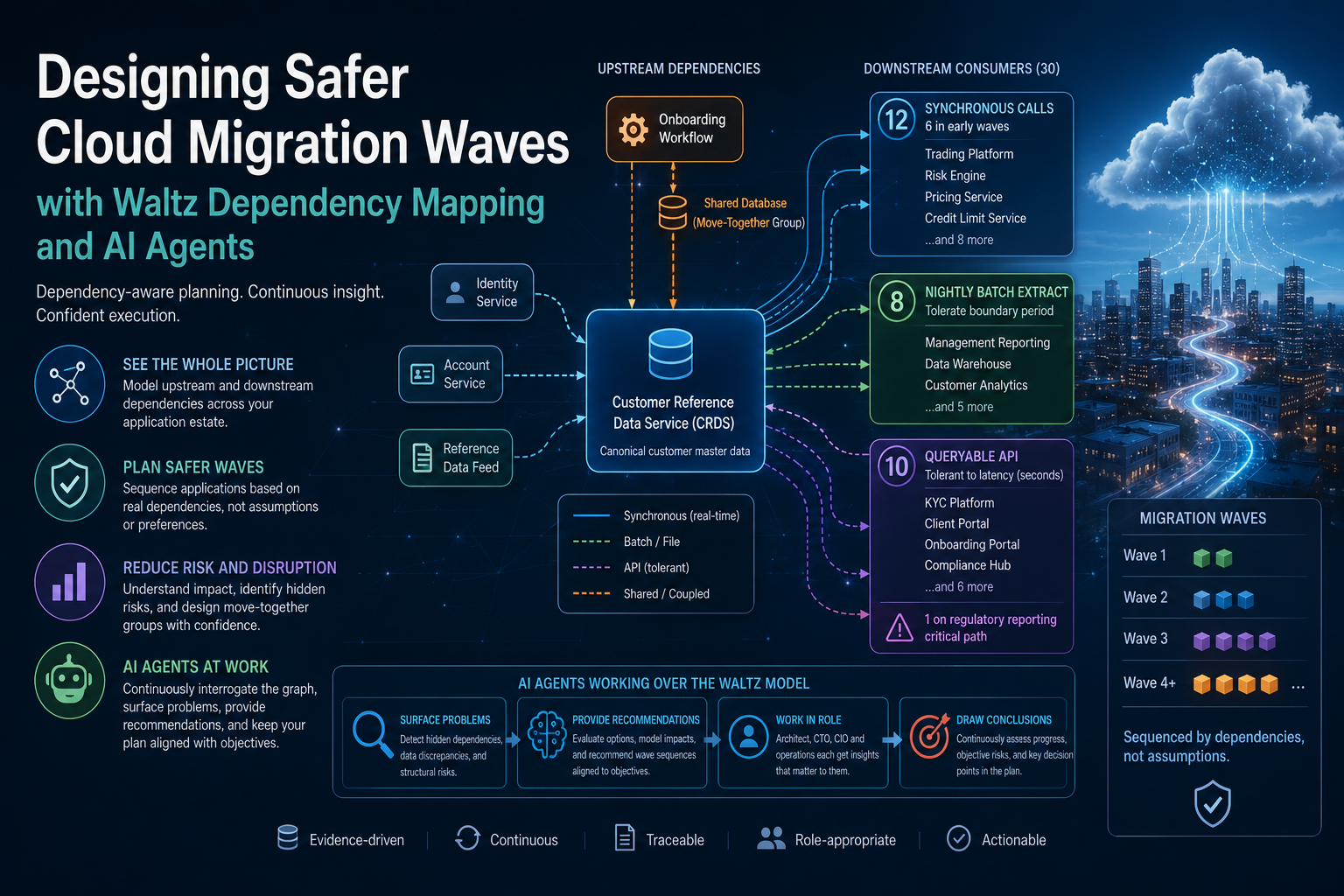
Those inputs matter, but they do not show the structure of the estate. The real question is dependency-aware sequencing:
- Can this application move independently?
- What must move before it?
- What must move with it?
- Who is affected downstream?
- Which bridges are needed during the hybrid period?
Where are the hidden risks in shared databases, batch jobs, APIs, scheduler dependencies, network flows, and cross-jurisdictional data movement?
Using Waltz, dependency mapping turns those questions into a navigable architecture model. Applications, logical flows, physical flows, interfaces, shared infrastructure, ownership, data classifications, and regulatory context can be connected and reasoned over.
The article also explores how AI agents can work over the Waltz graph to make migration planning more defensible at portfolio scale. AI Agents can surface discrepancies between evidence sources, identify structural risks, recommend wave options against stated objectives, and provide role-specific insights for architects, CTOs, CIOs, and governance teams.
The key point: AI agents do not replace architectural judgement. They make architectural judgement enforceable at scale.
A good migration plan is not just a list of applications. It is a sequenced traversal of an architecture model, supported by evidence, dependency visibility, and continuous challenge.
That is the difference between a wave plan that looks reasonable in PowerPoint and one that survives contact with execution.
Read the full article on cloudhpc.news
#CloudMigration #EnterpriseArchitecture #Waltz #AI #MigrationPlanning #ApplicationPortfolioManagement #DependencyMapping #CloudTransformation #ArchitectureGovernance